Sit Down Games for Senior Citizens
25+ Sit Down Games for Senior Citizens: Fun, Easy and Perfect for Any Occasion
Some of the best game nights do not involve moving around. There is something about sitting around a table with a group of older adults who have genuinely lived, who have stories behind every opinion they share, and who are absolutely not going to let you win just because you are younger, that makes for a completely different kind of fun.
My grandmother was the most competitive card player I have ever met. She would smile sweetly, offer you a biscuit, and then take every single point on the table without a flicker of guilt. She taught me that sitting down games are not passive. They are some of the most mentally sharp, and genuinely entertaining activities you can do at any age, and they only get better the more life experience you bring to the table.
Whether you are planning a family gathering, organizing activities at an assisted living facility, hosting a regular game night with older friends or relatives, or just looking for something wonderful to do with grandma and grandad on a Sunday afternoon, you will find everything you need right here.
Why Sit Down Games Are So Good for Seniors
Sit down games keep minds active and sharp. Card games, trivia, and strategy games all require memory, concentration, decision-making, and pattern recognition, which are exactly the mental muscles worth exercising at every age.
They create genuine social connection. Loneliness is one of the most significant challenges facing older adults and a regular game night, even a small one, gives people something to look forward to, conversations to have, and relationships to maintain.
They are accessible. Unlike physical activities that can be difficult or impossible for seniors with mobility challenges, sit down games require nothing more than a comfortable chair, a flat surface, and a willing group. Most can be adapted for players with visual or hearing impairments too.
Card Games for Senior Citizens
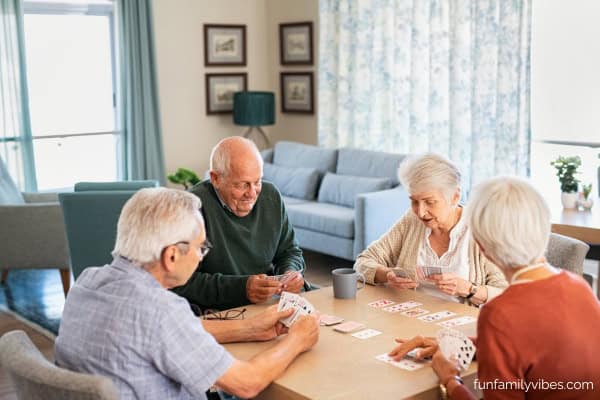
Card games are the gold standard of sit down games for seniors. They require almost no setup, travel easily, work for two players or twelve, and can be played at whatever pace suits the group. Most seniors already know several card games from earlier in life which means the learning curve is low and the enjoyment starts immediately.
1. Rummy
Players: 2 to 6
Difficulty: Easy to medium
Why seniors love it: Rummy is one of the most satisfying card games because it rewards the kind of patient, strategic thinking that comes with experience. The goal is to form sets and runs from the cards in your hand before your opponents do. It is easy enough for a complete beginner to pick up in one round but deep enough that experienced players always have an edge.
How to adapt it: Use large print cards if any players have visual impairments. The rules are flexible enough that you can adjust the winning score to make games shorter or longer depending on the group’s energy.
2. Gin Rummy
Players: 2
Difficulty: Medium
Why seniors love it: Gin Rummy is the two-player version of Rummy and it is one of the best games you can play one on one with a grandparent. The game requires reading your opponent, managing your hand carefully, and deciding exactly when to knock. It feels like a proper duel and every game tells its own story.
How to adapt it: Gin Rummy works as a tournament format if you have a larger group. Run several two-player games simultaneously and have winners play each other until you have a champion.
3. Canasta
Players: 4 (in partnerships of 2)
Difficulty: Medium
Why seniors love it: Canasta was enormously popular in the mid-twentieth century and many seniors have fond memories of playing it. It is a partnership game which means it combines individual skill with the satisfaction of working as a team. The goal is to build melds of seven cards called canastas and the scoring system rewards both strategy and speed.
How to adapt it: If four players is difficult to arrange, there are two and three player versions of Canasta that work just as well. The game takes about an hour for a full match which makes it perfect for an afternoon gathering.
4. Bridge
Players: 4 (in partnerships of 2)
Difficulty: Medium to hard
Why seniors love it: Bridge is one of the most intellectually challenging card games and it has an enormous following among older adults worldwide. It requires bidding, strategy, partnership communication, and memory all at once. Many seniors who play Bridge have been playing it for decades and the skill level in a regular Bridge group can be genuinely impressive.
How to adapt it: Bridge has a reputation for being complicated to learn from scratch but seniors who already know the basics will pick it up quickly. For groups where some players know Bridge and others do not, a teaching round with open hands is the best way to bring everyone up to speed.
5. Cribbage
Players: 2 to 4
Difficulty: Medium
Why seniors love it: Cribbage is one of the oldest card games still widely played and it is beloved by seniors for its combination of luck and skill. The pegging board is a satisfying physical element that keeps score in a tactile way, and the game moves at a comfortable pace that allows for plenty of conversation between hands.
How to adapt it: A standard Cribbage board is easy to read and handle. Large-print cards help if needed. The game works best as a two-player game but a four-player partnership version is also popular.
6. Solitaire and Patience Games
Players: 1
Difficulty: Easy to medium
Why seniors love it: Not every game needs to be multiplayer. Solitaire and its many variations, Klondike, Spider, Freecell, and FreeCell, are perfect for seniors who want mental stimulation during quiet time at home. A physical deck of cards keeps the hands and mind active in a way that a screen version simply does not replicate.
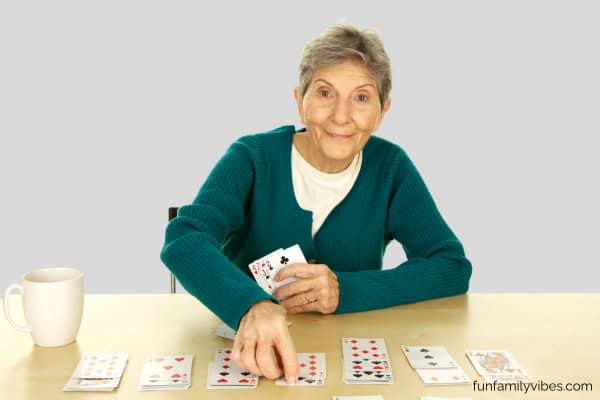
How to adapt it: Large-print playing cards make solo card games much more enjoyable for players with reduced vision. A card holder stand can also help players who have difficulty holding multiple cards at once.
7. Go Fish
Players: 2 to 6
Difficulty: Easy
Why seniors love it: Go Fish is the perfect game for a mixed age gathering where grandchildren and grandparents are playing together. It is simple enough for young children, familiar enough for seniors, and fast enough that nobody gets bored between turns. It also creates natural conversation as players ask each other for cards.
How to adapt it: Use oversized playing cards for easier handling and visibility. Go Fish can be played at whatever speed suits the slowest player without any loss of enjoyment.
8. Snap
Players: 2 to 6
Difficulty: Easy
Why seniors love it: Snap is pure chaos. The moment the matching cards hit the table and everyone lunges for the pile is genuinely exciting regardless of age. It is fast, funny, and requires absolutely no strategy whatsoever, which makes it the perfect palate cleanser between more serious games.
How to adapt it: For seniors with slower reflexes, adjust the rules so the first person to call snap rather than physically touch the pile wins the hand. This makes the game equally accessible for everyone.
Board Games for Senior Citizens
Board games bring a physical element to the table that card games do not always have. Moving pieces, rolling dice, and watching a board develop over the course of a game adds a visual and tactile dimension that many seniors find particularly satisfying.
9. Scrabble
Players: 2 to 4
Difficulty: Medium
Why seniors love it: Scrabble rewards vocabulary, pattern recognition, and strategic placement, and seniors with a lifetime of reading and language behind them often absolutely dominate it. The combination of individual word building and strategy on the board makes every game different and the social element of challenging words keeps everyone engaged.
How to adapt it: A large-print Scrabble set is available and worth investing in for regular play. Rotating tile holders help players who have difficulty holding multiple tiles. House rules like allowing a dictionary are a kind and sensible adaptation that keeps the game enjoyable for everyone.
10. Trivial Pursuit
Players: 2 to 6
Difficulty: Medium to hard depending on edition
Why seniors love it: The classic edition of Trivial Pursuit is loaded with questions from the decades that seniors lived through, which means their general knowledge is often a genuine advantage. History, geography, entertainment from the 1950s through 1980s, and sports are all categories where experience pays off.
How to adapt it: Look for the classic or vintage edition rather than modern versions which skew toward pop culture that seniors may not recognize. Alternatively, mix questions from multiple editions to balance old and new. Team play also works well, pairing a senior with a younger family member.
11. Mahjong
Players: 4
Difficulty: Medium to hard
Why seniors love it: Mahjong has been a beloved pastime for older adults for generations and with good reason. It combines tile recognition, pattern matching, strategic decision-making, and social interaction in a game that can be played at a relaxed pace or a competitive one depending on the group. Many seniors have been playing Mahjong for decades and bring a level of skill to the table that newer players genuinely aspire to.
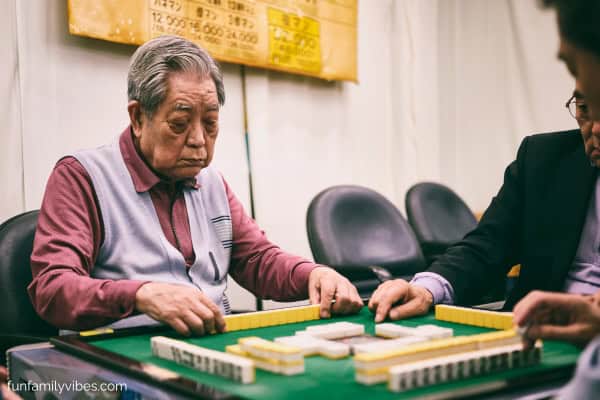
How to adapt it: Standard Mahjong tiles are a good size for handling. The rules can be simplified for mixed-ability groups while keeping the core game intact.
12. Chess
Players: 2
Difficulty: Medium to hard
Why seniors love it: Chess is the ultimate sit down game for strategic thinkers and many seniors have been playing it since childhood. It requires no luck at all, only skill, patience, and the ability to think several moves ahead.
How to adapt it: A weighted chess set with larger pieces is easier to handle and more satisfying to play with. For seniors who are newer to Chess, starting with simplified versions like pawn battles or limited piece games helps build confidence before moving to the full game.
13. Checkers
Players: 2
Difficulty: Easy to medium
Why seniors love it: Checkers is one of the most well known board games in the world and it has the perfect combination of simplicity and strategic depth. A game takes between fifteen and thirty minutes which makes it ideal for shorter visits or for seniors whose concentration is better in shorter bursts.
How to adapt it: Large piece checkers sets are widely available and worth using. The rules are simple enough to explain to any player in about two minutes.
14. Dominoes
Players: 2 to 6
Difficulty: Easy to medium
Why seniors love it: Dominoes is a wonderfully tactile game that works for almost any group size. The satisfying click of the tiles, and the combination of strategy and luck make it one of the most enjoyable and accessible games on this list. It has a long history as a social game played in community halls, clubs, and family kitchens.
How to adapt it: Standard dominoes are already a good size for handling. Jumbo dominoes sets are available for players with limited vision or dexterity. The game can be played at whatever pace suits the group.
15. Bingo
Players: Any number
Difficulty: Easy
Why seniors love it: Bingo is the gold standard of large group games for seniors for good reason. It is easy to understand, requires no prior experience, works for any group size from five to five hundred. The moment before someone calls Bingo when the whole room is one number away is a tension that never gets old.
How to adapt it: Large-print Bingo cards are essential for groups with seniors who have reduced vision. Use a microphone or clear loud voice for calling numbers. Themed Bingo with categories like animals, movies, or music makes the game feel fresh even for players who have done it many times.
16. Backgammon
Players: 2
Difficulty: Medium
Why seniors love it: Backgammon is one of the oldest board games in human history and it combines the unpredictability of dice with genuine strategic depth. The game moves at a good pace, a match takes between thirty and sixty minutes.
How to adapt it: Standard Backgammon sets have pieces that are easy to handle. The rules are learnable in one sitting for new players. Backgammon works particularly well as a tournament format at senior social gatherings.
Trivia and Quiz Games for Senior Citizens
Trivia games are among the best sit down activities for seniors because they draw directly on a lifetime of knowledge and experience. The right questions make seniors feel genuinely valued for what they know rather than disadvantaged by what has changed.
17. Classic Trivia Night
Players: Any number in teams
Difficulty: Adjustable
Why seniors love it: A well-run trivia night is one of the best social activities you can organize for a group of seniors. Teams of three to five people mean that everyone contributes something and no single player is on the spot. The conversation and debate that happens within each team is often as entertaining as the game itself.
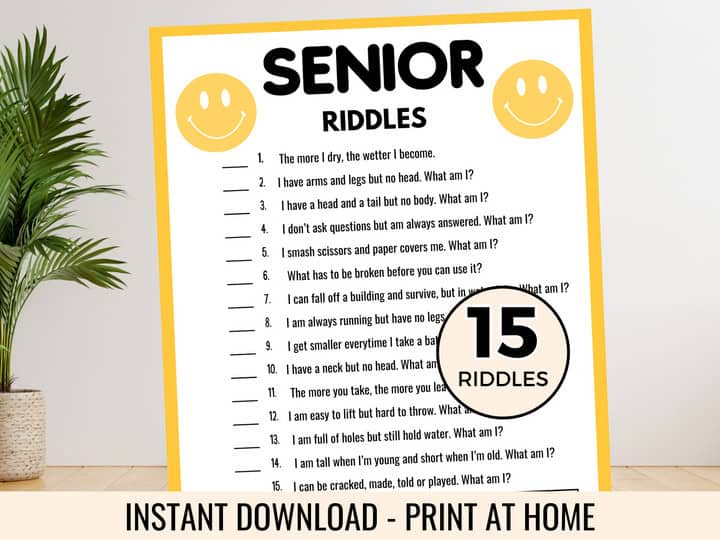
Tips for running it: Focus questions on history, geography, classic films, music from the 1940s through 1980s, literature, and general knowledge. Avoid questions about current social media, recent pop culture, or technology that would unfairly disadvantage older players. This printable Senior Riddles game is a great addition to any party.
18. Name That Tune
Players: Any number
Difficulty: Easy
Why seniors love it: Music often triggers memories and Name That Tune taps directly into that. Play the opening few seconds of a classic song and watch seniors light up with recognition before anyone else in the room has even processed that music is playing.
How to run it: Prepare a playlist of songs from the 1940s through 1980s covering multiple genres including jazz, country, rock and roll, and pop. Play the first ten seconds and give points for the title and artist. Round two can include lyrics where you read out a line and ask which song it is from.
19. Twenty Questions
Players: Any number
Difficulty: Easy
Why seniors love it: Twenty Questions requires no equipment can be played anywhere. One player thinks of a person, place, or thing and the group has twenty yes or no questions to figure it out.
How to adapt it: Start with the category, person, place, or thing, to make it more accessible. Allow unlimited questions for groups who find twenty too restrictive. The game works brilliantly in the car, around the table, or in any setting where a group is gathered.
20. Wits and Wagers
Players: 3 to 7
Difficulty: Easy to medium
Why seniors love it: Wits and Wagers is the trivia game where you do not need to know the answers. Players make numerical guesses and then bet on whose guess they think is closest. It means that strategic thinking and reading people matters just as much as knowledge, which levels the playing field for groups with mixed trivia abilities.
How to adapt it: The original game works well as is. For homemade versions, prepare a list of numerical questions, how many miles long is the Mississippi River, what year was the Eiffel Tower built, and run the betting format informally with chips or point tokens.
Word and Memory Games for Senior Citizens
These games are specifically good for keeping language skills, memory, and creative thinking active. Many can be played with no equipment at all which makes them perfect for smaller gatherings or impromptu game sessions.
21. Boggle
Players: 2 to 8
Difficulty: Medium
Why seniors love it: Boggle rewards vocabulary and pattern recognition at speed. Seniors with a strong reading and language background often do brilliantly and the three minute rounds mean the game moves quickly enough to play several in a row without anyone losing interest.
How to adapt it: Use a large print timer if needed. Allow a longer time limit for groups who find three minutes too short. House rules allowing two-letter words make the game more accessible for casual play.
22. Crossword Puzzles Together
Players: Any number
Difficulty: Adjustable
Why seniors love it: Doing a crossword as a group is a completely different experience from doing one alone. One person reads the clues, others call out suggestions, and the social energy of solving it together makes even a difficult puzzle feel achievable.
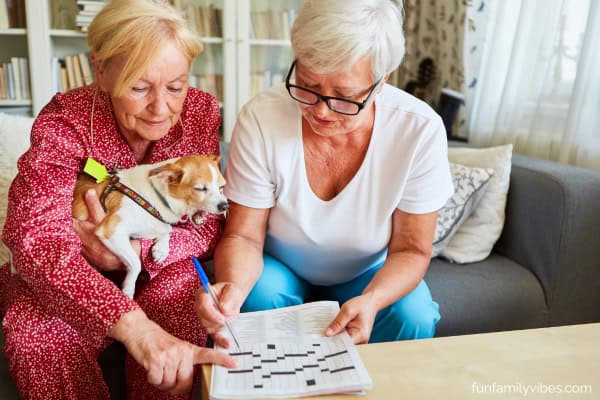
How to adapt it: Print the crossword in a large format so everyone can see it. Assign one person to write answers and rotate the role. Set a time limit per clue to keep things moving.
23. Alphabet Game
Players: Any number
Difficulty: Easy
Why seniors love it: The Alphabet Game requires no equipment and works in any setting. Players take turns naming something within a category, animals, foods, cities, movies, for each letter of the alphabet in order. It sounds simple and it is, but it gets increasingly difficult as you reach letters like Q and X and the group has to work together to keep the chain going.
How to adapt it: Choose categories that suit the group. Classic film titles, capitals of the world, and famous historical figures are all great options for seniors. Allow team collaboration for harder letters.
24. Story Chain
Players: Any number
Difficulty: Easy
Why seniors love it: Story Chain is one of the most creative and entertaining games on this list and it produces some genuinely memorable moments. One player starts a story with a single sentence. The next player adds a sentence. The story continues around the group with each player adding one sentence at a time. The results are always unexpected and often hilarious.
How to adapt it: Give players a theme or a starting line to work from if they need a jumping off point. Allow players to pass if they get stuck. The game works best with a time limit of about thirty seconds per turn to keep the energy moving.
25. Word Association
Players: Any number
Difficulty: Easy
Why seniors love it: Word Association is a fun game. One player says a word, the next player immediately says the first word that comes to mind, and the chain continues around the group. The moment someone hesitates too long or repeats a word they are out, and the last player standing wins.
How to adapt it: For a more relaxed version, remove the elimination element and just play for the joy of seeing where the chain goes. Some of the most interesting conversations start from an unexpected word association.
Other Sit Down Activities Seniors Love
Not everything has to be a competitive game. These activities are just as social and engaging but without the scoring.
26. Jigsaw Puzzles
Jigsaw puzzles are one of the most loved sit down activities for seniors. They are calming, satisfying, and work for any group size since multiple people can contribute at once. A partially completed puzzle left on a table invites people to stop and add a piece every time they walk past, which creates a lovely ongoing shared activity over the course of a visit. Choose puzzles with larger pieces for seniors with visual impairments or limited dexterity.
27. Card Making and Crafts
A crafting session around the table is a great social activity that produces something tangible at the end. Card making, simple watercolor painting, or working on a shared collage gives hands something to do while conversation flows naturally. Many seniors find that their best conversations happen when their hands are occupied with something simple.
28. Memory Match
Players: 2 to 6
Difficulty: Easy
Why seniors love it: Memory Match, the game of turning over pairs of matching cards, is good for memory training and is far more competitive than it looks. Seniors who play regularly develop impressive recall and the game works for any group size.
29. Yahtzee
Players: 2 to 6
Difficulty: Easy to medium
Why seniors love it: Yahtzee is the perfect combination of luck and strategy. Players roll five dice up to three times per turn, trying to achieve specific combinations on their score sheet. It is fast and produces genuine moments of excitement when the dice cooperate and genuine commiseration when they do not.
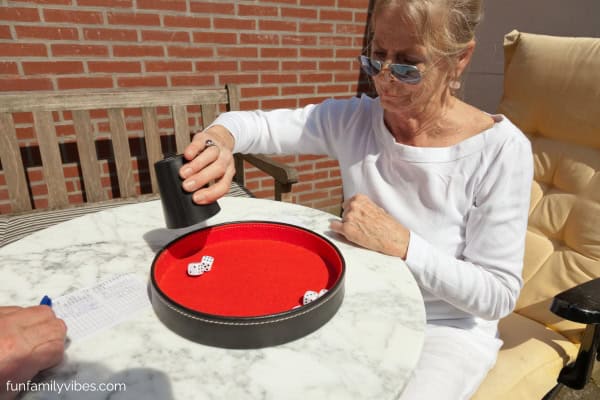
How to adapt it: Large print score sheets are available and easy to make at home. The dice are already a good size for handling. Yahtzee works brilliantly as a tournament format for larger groups.
30. Pictionary
Players: 4 to 8 in teams
Difficulty: Easy
Why seniors love it: Pictionary produces more laughter per minute than almost any other game on this list. The combination of someone desperately trying to draw something recognizable while their team shouts increasingly wrong answers is universally entertaining. Seniors often have a brilliant sense of humor about their own artistic limitations which makes them some of the best Pictionary players around.
How to adapt it: Use a large whiteboard or pad of paper so everyone can see clearly. Simplify the categories and avoid overly modern pop culture references in the word selection. Allow more time per drawing for groups that need it.
31. Storytelling with Old Photos
This is not a game in the traditional sense but it is one of the most meaningful sit down activities you can do with seniors and one that families return to again and again. Bring a collection of old photographs, family photos, historical images, or pictures from the era when the seniors in your group were young, and let each person pick one to tell a story about.
The conversations that come from this activity are unlike anything a board game or card game produces. Stories emerge that family members have never heard. Memories surface that might otherwise be lost.
Tips for Running the Best Game Sessions for Seniors
Let them choose. Ask what games they want to play rather than assuming. Many seniors have strong preferences and clear favorites and choosing for them can feel dismissive of their autonomy. Their answer will also tell you a lot about what kind of session is going to work best.
Keep the space comfortable. Good lighting, comfortable chairs, a table at the right height, and a temperature that is not too cold are not minor details. They are the foundation of an enjoyable session. Check all of these before anyone sits down.
Match the pace to the group. Some seniors want a fast-moving competitive game. Others want something relaxed where conversation is as important as play. Read the room and adjust accordingly. A game that moves too fast creates stress rather than enjoyment.
Have snacks on the table. There is a reason every great card game ever played had food nearby. Snacks slow the pace in a good way, give people something to do between turns, and make the whole gathering feel warmer and more social.
Do not keep score if it creates stress. Friendly competition is wonderful. But if keeping score is making anyone feel self-conscious or anxious, drop it. The social connection is more important than who wins and the games are just as enjoyable without points.
Rotate games throughout the session. Two hours of the same game can feel long. A mix of two or three different games keeps the energy fresh and means that players who are not as strong at one game get a chance to shine in another.
Keep a regular schedule. A weekly or fortnightly game session gives seniors something to look forward to and a social structure that supports wellbeing far beyond the games themselves. Regularity matters as much as the activity.
Printable Games for Seniors Worth Having Ready
If you want something ready to go without any setup, these printable Senior Games are a great addition to any senior game session. They work well as an icebreaker, a warmup activity, or a standalone game for smaller gatherings.